
When a financial institution needs to price a loan, having the most amount of information possible is key. For this reason, the gold standard for lenders has been utilizing tri-merge credit reports. This method works by ordering credit reports from TransUnion, Experian, and Equifax, and taking the middle credit score of the 3. However, some lenders have taken a different route recently when pricing their loans.
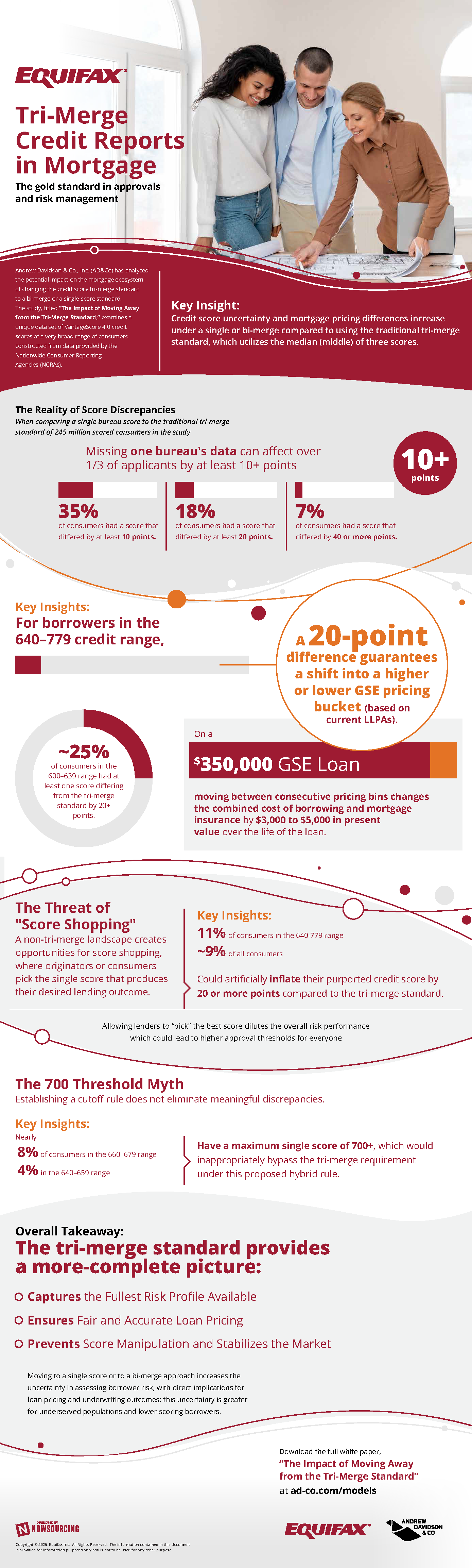
Rather than using a tri-merge credit report, lenders have ordered credit reports from only 2 of these credit bureaus. While this may seem like a small difference, some very large variances have been observed. Currently, it is estimated that around 1 in every 5 consumers saw a credit score variable of 20 points or more. Consequently, these prospective borrowers have had their price bucket improperly categorized, meaning they were either undercharged or overcharged for their loan. On a $350,000 loan, this could mean a discrepancy between $3,000 and $5,000.
Fortunately, this is preventable. Ordering credit reports from all 3 bureaus not only reduces credit score variance, but ensures that all available financial information is on the table for the lender to review. If you want to make sure loans are appropriately priced for the right customers, relying on tri-merge credit reports is the way to go.
Source: Equifax